Talk to an Expert
Talk to an Expert
A New Orleans yard is not an easy place for outdoor lights. Live oaks throw deep shade across whole lots, summer storms drop heavy rain in short bursts, and the ground in many neighborhoods stays wet for days afterward. All three affect which outdoor lighting system will work for you.
Your outdoor lights do their job quietly, until the path is dark, the solar lanterns fade by nine o’clock, or the security light you wanted never quite gets installed. At TurnKey Lightings, we design and install outdoor lighting for New Orleans homes, and the first decision on almost every job is which kind of system to use.
This guide explains how low-voltage, solar and line-voltage lighting differ, the signs that point toward each one, and how local conditions change the answer. It also covers when it makes sense to combine them.
If you would rather have someone look at your yard and recommend a system, contact us and we will walk it with you.
The three systems differ mainly in where their power comes from and how much of it they carry. That difference drives everything else, from how the cable is run to who should install it.
A low-voltage system runs from a transformer. As a Landscape Architect article on outdoor lighting design puts it, the transformer reduces standard 120-volt power from your home to 12 volts. Fine Homebuilding describes the same setup, stepping 120 volts down to a safer 12 volts.
The fixtures then connect along low-voltage cable. Both sources note that this cable can be run shallow, buried in a shallow trench or concealed under a few inches of soil, mulch or ground cover.
Solar fixtures carry their own small panel and battery. They charge during the day and switch on at night, with no wiring back to the house at all. Setting them out takes minutes, which is why they are so common in garden centers.
That independence is their main appeal. It is also their main limitation, because each fixture can only give back the energy its panel collected that day.
Line-voltage lighting runs at standard household voltage, 120 volts, the same as an outlet in your home. According to the Landscape Architect article, these systems are used where brilliant illumination is needed for safety or security, and their installation is more complicated than a low-voltage system.
Line-voltage outdoor wiring is electrical work in every sense, so it belongs with a licensed electrician who can make sure it meets local electrical codes.
Put side by side, the trade-offs are easy to see:
None of the three is better in every yard. The right choice depends on what each part of the yard needs to do after dark.
For most residential landscape lighting, low-voltage is where the conversation starts. These are the signs it is the right fit for you.
If the goal is to light trees, beds, paths and the front of the house as one designed scene, low-voltage is usually the natural choice. It supports many fixtures on a single system, aimed and placed individually.
This is the kind of work our landscape lighting service is built around, from uplighting a canopy to washing a wall.
Gardens change. Shrubs grow, trees spread, and new beds go in. Fine Homebuilding notes that low-voltage systems are safer and more flexible for homeowners to adjust and maintain on their own.
A fixture can be moved a few feet or re-aimed as the planting matures, without opening up the house wiring.
That flexibility matters in New Orleans, where a young magnolia or a new bed of ginger can change the shape of a yard within a couple of seasons. A system that can grow with the garden keeps looking intentional, not dated.
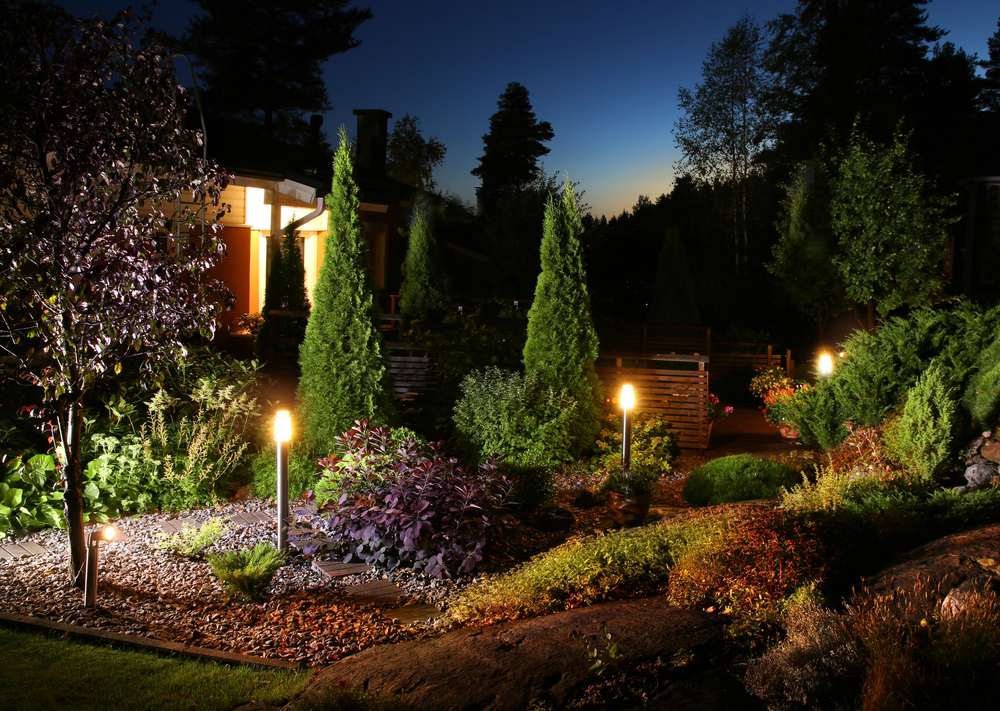 Wherever people walk at night, the light has to come on every evening and stay on. Front steps, porch stairs, garden paths and the walk from the driveway to the door are the places where a dim or dead fixture causes a stumble.
Wired low-voltage fixtures handle this well, because they do not depend on how much sun reached a panel that day. Our pathway lighting work focuses on exactly these routes, so the light lands on the ground where your feet go.
Raised New Orleans homes often have long front stairs and side steps, which makes this even more important. Light at each change in level helps far more than one bright fixture at the top.
Distance matters. Fine Homebuilding points out that beyond about 100 feet, the wire’s resistance can cause a significant reduction in the voltage reaching the farthest fixtures.
On long runs, the layout has to account for that, through how the cable is routed, how the fixtures are grouped or where the transformer sits. A well-planned system keeps light even from the first fixture to the last.
This is one of the most common problems with systems put together piece by piece over the years. Each addition gets tacked onto the end of an existing run, and the far end of the yard slowly gets dimmer than the front.
Low-voltage is not always the answer. In some spots, one of the other two systems makes more sense.
A far corner of the yard, a gate post across a driveway or a bed separated from the house by pavement can be hard to reach with cable. Solar fixtures can make sense in places like these, because they need no wiring at all.
The trade-off is brightness. Our own service page notes that solar lights are an eco-friendly option that charge from the sun, though they are less bright.
Solar works best as an accent in a sunny spot: a marker light by a gate, a glow in a flowerbed or a lantern on a fence post. It is a poor fit wherever you need dependable light for walking or for security.
When the job is security, a large parking area or a long driveway that needs strong, reliable light, line-voltage lighting is often the better fit. As the Landscape Architect article says, line-voltage systems are used where brilliant illumination is required for safety or security.
These installations need a licensed electrician, and they take more planning than a low-voltage layout.
That planning covers more than the fixture. Where the circuit comes from, how the wiring reaches the light, and whether the work needs a permit are all questions for the electrician. Bright security lights also need careful aiming, so they light your driveway and entry without shining into a neighbor’s windows.
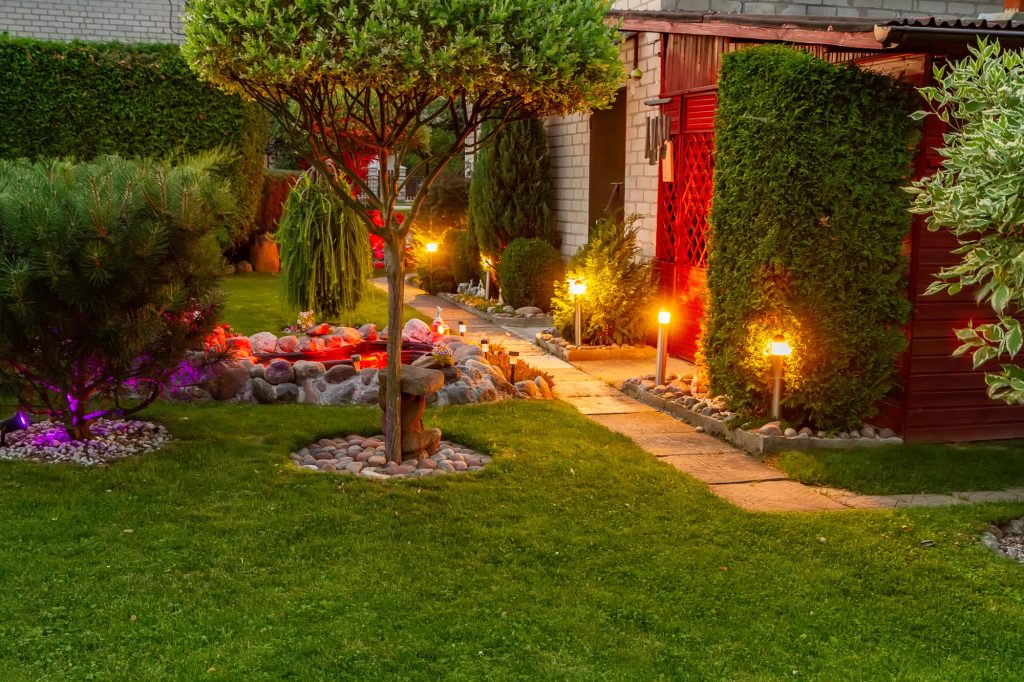 Solar fixtures depend on sunlight reaching their panels. Under a dense live oak canopy, on the shady side of a house or in a narrow side yard, a solar fixture may never collect a full charge.
If the spots you want lit are mostly in shade, a wired system will give you far more consistent light from night to night.
Panel placement can help in partly shaded yards. Some solar fixtures allow the panel to sit apart from the light itself, so the panel can catch sun while the fixture stays where it is needed. Even then, a run of cloudy, rainy days can leave it short of charge.
The same three systems behave differently here than in a dry, open yard elsewhere. Shade, rain, storms and lot shape all push the choice one way or another.
The table below sets out the local factors that most often change the recommendation.
| Local Factor | Effect on Outdoor Lighting | What Helps |
|---|---|---|
| Heavy shade from live oaks | Solar panels under the canopy may not collect enough charge for a full night | Use wired low-voltage fixtures in shaded areas and keep solar for open, sunny spots |
| Heavy, frequent rain | Connections and cable runs spend long stretches in wet ground | Quality connectors, careful routing away from low spots, and periodic checks |
| Storms and falling debris | Fixtures get knocked out of aim and solar panels get covered by leaves | Check and re-aim fixtures after storms, and clear panels of leaves |
| Long, narrow lots | Low-voltage runs from a single transformer can get long enough to dim the farthest fixtures | Plan the layout so cable runs and fixture groups keep light even along the lot |
Shade is the factor we see most often. Our guide to lighting live oaks and mature trees shows how much of a yard those canopies cover. For why fixtures wear out faster here, see our post on why outdoor lighting fails faster in New Orleans.
Many yards end up using more than one system. A wired low-voltage layout can carry the main beds, trees and paths, while a solar fixture or two covers a hard-to-reach corner, and a line-voltage security light watches the driveway.
Before choosing, it helps to answer a few questions about your own yard:
The answers usually point to a clear mix, and they make the design conversation much quicker.
The right outdoor lighting system depends on what you want to light, how much shade the yard gets, and how far the light has to reach. For most landscape and path lighting, low-voltage is the flexible starting point, solar fills gaps where wiring is impractical, and line-voltage handles bright security lighting with a licensed electrician.
Getting the system right at the start is what keeps your lighting consistent for years. Changing systems later usually means digging up beds and paths that have already settled in. Spacing matters too, which is why we cover pathway lighting spacing separately.
At TurnKey Lightings, we design and install residential outdoor lighting around the way your yard is actually used, from the front walk to the back garden.
To talk through the right system for your yard, call us at (504) 688-7205.
Is low-voltage outdoor lighting safe?
Low-voltage systems use a transformer to step household power down to 12 volts, which Fine Homebuilding describes as safer. Quality components and careful installation still matter, because the transformer itself connects to household power. Any work on the household side belongs with a licensed electrician.
Are solar outdoor lights worth it in New Orleans?
They can be, in the right spots. Solar fixtures work best where their panels get direct sun, and they are less bright than wired fixtures. Under heavy tree cover or after several rainy days, they may not charge enough to stay on through the night.
What is the difference between low-voltage and line-voltage lighting?
Low-voltage lighting runs at 12 volts through a transformer, while line-voltage lighting runs at standard 120-volt household power. Line-voltage is typically used where bright light is needed for safety or security, and its installation is more complicated.
How deep does low-voltage cable need to be buried?
Both trade sources we checked note that low-voltage cable can be run shallow, in a shallow trench or under a few inches of soil, mulch or ground cover. Local requirements and the manufacturer’s instructions should still guide each installation. In beds you dig often, route the cable where a shovel is unlikely to find it.
Can I mix solar and low-voltage lights in the same yard?
Yes. Many yards use a wired low-voltage system for the main beds, trees and paths, with solar fixtures in spots that are hard to reach with cable. The key is matching each fixture to the spot it has to light, and keeping the color of the light similar so the two systems look like one design.
Why do the far lights on my system look dimmer?
On long low-voltage runs, wire resistance can reduce the voltage reaching the farthest fixtures, and Fine Homebuilding notes this becomes significant beyond about 100 feet. The fix is usually in the layout, how the cable is routed and how the fixtures are grouped.
Do I need an electrician for outdoor lighting?
For line-voltage lighting and any work on household circuits, yes. A licensed electrician should handle the wiring and make sure it meets local electrical codes. Low-voltage systems still benefit from professional design and installation, especially on larger yards with long cable runs.
Which system is best for home security lighting?
For bright, dependable light over a driveway, entrance or large area, line-voltage lighting is often the better choice. Low-voltage path and accent lighting can add to security by keeping walkways and entries visible, but it is not designed to flood a large area with light. Many homes use both together.