Talk to an Expert
Talk to an Expert


Lights with a color temperature of 2700K–3000K are best suited for living rooms and bedrooms, creating a warm and cozy atmosphere. Cooler lighting (4000K–5000K) works well in kitchens and home offices, where concentration and clarity are important. Bathrooms benefit from a warm white range between 3500K and 4000K, offering a neutral tone that maintains brightness without being too harsh.
Understanding how lighting affects mood and function helps you design a space that feels truly personal. Let our experts at TurnKey Lightings guide you in choosing the perfect color temperature for your home.
Contact us anytime to schedule a consultation and start creating a lighting design that fits your style and needs.

Color temperature describes how a light appears, ranging from yellow/red to cool blue mode, using a measure of the Kelvin degree, which has the designation of K. The lower values create warmer lighting, though it is suitable for all cozy spaces, while those on the higher end are suitable for all work environments.
The Kelvin scale helps you choose the right type of lighting for your space. Warm light (2000K–3000K) gives off a cozy glow similar to candlelight. Neutral light (3500K–5300K) offers a balanced brightness that works well for most rooms. Cool light (6500K and above) feels like natural daylight and helps people stay alert and focused.
Natural sunshine has its changes-warm tones in the morning and evening (2000K-3000K), cooler tones at noon (5000K-6500K). To enhance these changes, the artificial lights are selected so as to create a harmonious arrangement.
Light has the authority to either create ambiance or energize a space, depending on which kind of light is used. Cool light is commonly used in offices to highlight energy and concentration. Individual perception of light varies with sensitivity, age, and preference, which is why selecting the correct light for a particular setting is important.
Light affects how people feel, think, and function every day. Knowing how color temperature influences our mood and functionality allows us to create lighting schemes that meet our needs and lifestyles.
Biologically, light influences our SCN by means of light-sensing cells, especially the cells that are sensitive to blue light. Therefore, part of the lighting psychology explanation is this relationship.
Warm light (about 3000K) induces a cozy atmosphere; just the right kind for living rooms and dining rooms, it says `relax’ after a hard day. Dim warm lighting encourages sleep, hence it is apt for bedrooms. Cameras proficient at nice white light exist and recommend all named here for admirable compositions of furniture and home office.
Productivity is significantly enhanced with cool white light, and focus and task performance essentially mimic the agility found in natural sunlight. Use bright lighting in the vicinity of reading or office activities; this facilitates sight while minimizing mistakes.
Dimmable LEDs are remarkably adaptable, allowing for easy transitions from work to leisure; they enhance sight with good illumination, making them doubtlessly handy in any home office or study.
Light is closely linked with the circadian rhythms. While cooler light during the day enhances alertness, warmer light at night tells us to rest. Therefore, an artificial lighting scheme aligned to these rhythms will enhance sleep and wellbeing-warm in the bedroom and cooler in morning areas for energizing and mood enhancement.
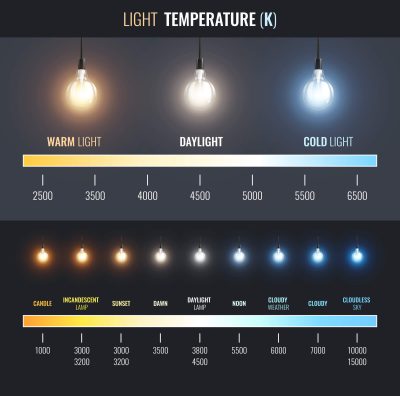
Near the start, it would be wise to define color temperature, a characteristic expressed in Kelvin (K), which will influence mood and ambiance. Here are some guidelines for selecting light for different areas:
Warm tones (2700K-3000K): Suitable for intimate areas such as bedrooms and living rooms.Cooler tones (4000K-5000K): Preferred for more task-oriented areas such as kitchens and offices.
Somewhere between general, task, and accent lighting should be dimmable for maximum effect.
To create a warm and cordial ambiance, target illumination of color temperature evaluation of 2700K-3000K. Dimmable lighting sets the mood for movie nights or entertaining, and accent lighting gives dimension and interest to the decor.
Bright light (3000K-4000K) should be adopted for food preparation under overhead lighting; it allows for seeing the colors of food items. Warmer light (2700K-3000K) is for dining.
Bedrooms benefit from warm, dimmable lighting around 2700K–3000K. This type of light helps the body relax and prepares it for rest. Use bedside lamps or wall sconces with soft tones to make evenings calmer and more comfortable.
Bright lighting, about 3000K-4000K, for mirror use and accurate color differences. The highest CRI will help make skin tones look best. Layered lighting will add to the spa effect.
Cooler for productivity (3000K-5000K). Adjustable task lights to prevent glare and eye strain, while layered will shift toward functional and comfort.
The color temperature you choose has a big impact on the atmosphere and function of a room. Warm tones create a cozy, relaxing feel, while cooler tones help improve focus and alertness. The right lighting doesn’t just brighten your space—it sets the mood and supports how you live and work each day.
A thoughtful design can truly make your home feel more inviting and balanced. Call us today at TurnKey Lightings for your custom lighting design!