

Talk to an Expert
Talk to an Expert
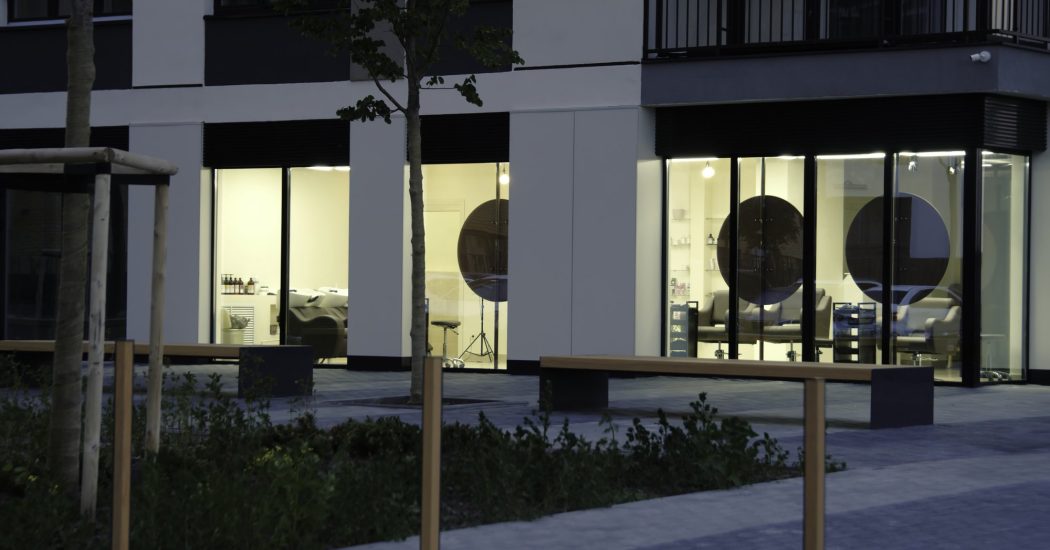
If your storefront goes dark the moment the sun sets, customers driving past may not know you are open. A lit entry, a readable sign and a parking area people feel comfortable crossing all do work after hours.
In New Orleans, that lighting also has to meet city rules. The Comprehensive Zoning Ordinance sets limits on how much light can cross a property line, and buildings in local historic districts add Historic District Landmarks Commission (HDLC) review.
At TurnKey Lightings, we design energy-efficient outdoor lighting for businesses across the New Orleans area, planned around the entrance, the pathways and the signs.
If you are planning new exterior lighting for your business, contact us and we will walk the property with you.
The steps below follow the order a commercial lighting plan usually takes, from the night walk to the final approvals.
Inside city limits, Section 21.5 of the New Orleans Comprehensive Zoning Ordinance caps exterior light at 0.5 footcandle at a residential property line and 1 footcandle at any non-residential property line or public right-of-way line.
Three things shape a commercial lighting plan here: what the property needs, what the zoning rules allow and, for historic buildings, what the HDLC approves. A plan that ignores any one of them usually ends up being redone.
The needs come first. A restaurant with outdoor seating, a retail shop on a commercial corridor and an office with a back parking lot each ask lighting to do different jobs. On our commercial lighting page we put it this way: brighter light in parking areas, softer light near seating, all blended with your brand.
For properties inside the City of New Orleans, Section 21.5 of the Comprehensive Zoning Ordinance (CZO) sets the baseline. It says no exterior lighting may glare into or upon the surrounding area or any residential premises, or interfere with the safe movement of vehicles on public streets.
The same section sets measurable limits:
If the building sits in a local historic district, the HDLC’s Guidelines for Commercial Buildings apply as well. The HDLC frames the goal as a balance between providing enough light to create a secure feeling and fitting within the neighborhood context.
The HDLC also states that all lighting should illuminate only the building, walkway surfaces and parking areas, without spillover onto adjacent properties or into the night sky. The CZO is the City of New Orleans ordinance, so a property in Metairie or Kenner needs its own local rules confirmed before design starts.
A commercial lighting plan starts with a night walk, not a fixture catalog. Seeing the property after sunset shows where light is missing, where it is too harsh and where it already spills past the property line.
On that walk, note these points:
The neighbor question matters more than it seems. Because the CZO measures light at the property line, a fixture aimed toward a residential lot has a tighter limit than one facing a commercial neighbor.
Write down what each area needs before choosing anything. Our commercial outdoor lighting work groups those needs into four types: architectural lighting for the building, landscape lighting for grounds and paths, signage and display lighting, and holiday and event lighting.
The entry is where a customer decides to come in, so it gets the first and most careful light. On our commercial outdoor lighting page we note that the entrance, the pathways and the signs deserve the most care.
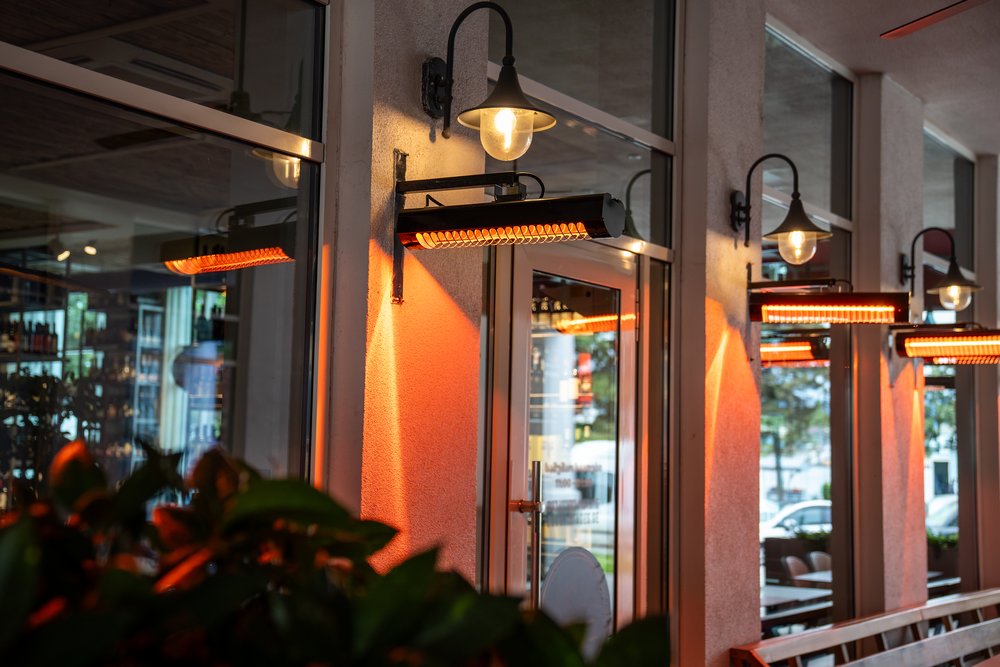 Decorative fixtures belong here, and only here in most cases. The HDLC’s commercial guidelines say decorative lighting is the only type that should be highly visible at a facade, with New Orleans examples such as gas lamps, marquees, neon and seasonal lighting. In most cases, the number of decorative lights should be limited and located at the primary entrance.
The rest of the storefront can glow without showing its fixtures. The HDLC describes ambient lighting as a wash of general illumination across the storefront and sidewalk, sometimes with up-lighting of the facade, and gives recessed lighting under a gallery as its example.
The HDLC also encourages fixtures that produce an even wash of light without hot spots or shadowed areas. An evenly lit storefront reads as open and cared for, while a single bright fixture over the door can leave the windows and sidewalk dark.
On historic and modern buildings alike, up and down fixtures can show off columns, piers and facade texture. Our up/down lighting service uses weather-resistant fixtures that light building exteriors, walkways and parking lots.
A sign needs enough light to be read, and not much more. The HDLC’s commercial guidelines say that in many cases, existing street or storefront lighting can illuminate a sign, which it prefers to adding new fixtures.
When a sign does need its own light, the HDLC says gooseneck lighting or another unobtrusive fixture is often the most appropriate choice for wall signage. It also recommends reducing the number of lamps so they provide just enough light for the sign to be read.
Some sign lighting is off the table in local historic districts. The HDLC does not permit:
The HDLC also discourages signs that block views into the store through storefront windows. A lit display window can do part of a sign’s job after dark, so keeping that view open helps both.
Outside historic districts, the CZO still applies. Any sign light that produces glare that could disturb a driver, or that could be mistaken for a traffic signal, is prohibited by Section 21.5.
Parking and walkway lighting has two jobs: help people see where they are walking, and keep that light on your property. The HDLC asks for freestanding lighting such as parking lot lights to provide a uniform lighting pattern while keeping the fixture itself low-key during the day.
Height is where the rules become numbers. Under the CZO, light poles and building-mounted fixtures for non-residential uses are limited to 18 feet, measured from grade at the base to the bottom of the luminaire. In local historic districts, the HDLC does not permit freestanding lights taller than 25 feet, so inside city limits the CZO’s 18-foot limit is the lower of the two.
The HDLC adds that all freestanding lighting must be installed on poles designed for that purpose.
Shielding keeps a parking lot from lighting the block. The CZO requires fully shielded luminaires on these poles and mounts, and DarkSky’s Approved Luminaires program says most of its approved fixtures must send 95 percent of their light below 80 degrees.
Walkways tie the lot to the door. Low path lights or bollards along the route can put light on the ground without adding height, which is useful when a commercial lot backs up to houses and the 0.5 footcandle limit at the residential line applies.
Pole lights and building-mounted fixtures that run on household power are electrical work, and installing or moving them belongs with a licensed electrician.
Security lighting protects the property without becoming the face of it. The HDLC says security lighting should be as discreet as possible, preferably on rear or non-street elevations, limited in number and activated by motion sensors whenever possible.
That matches how most commercial sites work. The front is lit for customers during open hours, while the sides, the back door, the dumpster area and the loading zone need light that turns on when someone is there.
Motion sensor lights fit that second job well. Our commercial lighting plans use them for security and energy savings on driveways, pathways and garden areas.
Floodlights are the common shortcut, and the HDLC does not permit them, or fluorescent tube lighting, at street elevations. Its commercial lighting guide repeats the point for street-facing elevations and asks that the number of light fixtures and cameras be limited to the minimum necessary.
Outside historic districts, the CZO’s glare rule still applies to every security fixture. A bright, unshielded flood aimed toward the street or a residential lot can break the limit even when the intent is safety.
With the plan mapped, the last step turns it into fixtures, controls and paperwork. Doing them together keeps the design from changing after the approval comes back.
For fixtures, shielding and dimming are the two features to check first. DarkSky’s 2025 program packet says its commercial luminaires use reduced lumen output and stricter high-angle limits for pedestrian comfort, and that approved luminaires must have a dimming option.
For controls, DarkSky notes that approved luminaires can be combined with controls to turn off or dim the product when not needed. Our smart systems let a business manage lighting remotely and schedule it so it is on only when needed.
For approvals in a local historic district, the HDLC’s commercial guide says a Certificate of Appropriateness is required before installing or modifying light fixtures visible from the public right-of-way. Applications are submitted online at onestopapp.nola.gov, and the HDLC states that CofAs carry no cost.
Many lighting installations qualify for the HDLC’s expedited ExpressLane review if they meet its design guidelines. The HDLC lists installing new appropriate lighting as a staff-level review, and its office can be reached at (504) 658-7051.
Plan for temporary displays too. The HDLC’s commercial guide allows temporary decorative lighting for up to 90 days per calendar year, and it does not permit string lights that are permanently installed without an electrical permit or are highly visible. Inside the city, the CZO also limits strung, unshielded bulbs to temporary use at approved carnivals, fairs and similar events.
A storefront’s lighting is part of its sign, its security and its welcome. In New Orleans, it also has to stay under the CZO’s property-line limits and, on historic buildings, pass HDLC review.
The front of a business deserves the same care as the front of a home, which our guide to curb appeal lighting for New Orleans homes covers on the residential side. Choosing between low-voltage, solar and line-voltage lighting matters for commercial grounds as well.
Fixtures also need to survive our climate. Our post on why outdoor lighting fails faster in New Orleans explains what heat, humidity and storms do to an outdoor system.
At TurnKey Lightings, our commercial lighting services cover outdoor, garden, LED and up/down lighting. For qualified purchases, we schedule installation around your business to keep disruption low.
To light your storefront the right way, call us at (504) 688-7205.
Inside city limits, the Comprehensive Zoning Ordinance limits light to 0.5 footcandle at a residential property line and 1 footcandle at a non-residential property line or public right-of-way line. It also bans exterior lighting that glares onto surrounding areas or interferes with traffic.
Under CZO Section 21.5, light poles and building-mounted fixtures for non-residential uses are limited to 18 feet, measured from grade to the bottom of the luminaire, with higher limits only for certain industrial uses. In local historic districts, the HDLC separately does not permit freestanding lights taller than 25 feet.
If the building is in a local historic district, the HDLC requires a Certificate of Appropriateness before you install or change light fixtures visible from the public right-of-way. The certificate is free, applications go through onestopapp.nola.gov, and many lighting projects qualify for ExpressLane review.
In local historic districts, the HDLC does not permit floodlights or fluorescent tube lighting at street-facing elevations. Elsewhere in the city, any fixture still has to stay within the CZO’s glare and property-line limits, so shielded, aimed fixtures are the safer choice.
In local historic districts, the HDLC allows temporary decorative lighting for up to 90 days per calendar year and does not permit string lights that are permanently installed without an electrical permit or are highly visible. The CZO also restricts strung, unshielded bulbs to temporary use at approved carnivals, fairs and similar events, so check before planning a permanent installation.


