

Talk to an Expert
Talk to an Expert
In New Orleans, sunset moves by about three hours over the year. The U.S. Naval Observatory puts it at 8:04 PM on June 21 and 5:01 PM on November 26 this year, so outdoor lights set by a plain clock in summer can switch on long after dark by Thanksgiving.
That swing is why the control matters as much as the fixtures. A timer, a photocell or a smart control decides when your lights come on, how long they stay on and whether you ever have to think about them.
At TurnKey Lightings, we match the fixtures, the placement and the controls to how you use your outdoor space, and we show you how to run the system once it is in.
If you want help picking controls for a new or existing system, contact us and we will plan them with you.
This guide covers how much our evenings change, when each type of control fits and how local conditions change the setup.
Sunset in New Orleans ranges from just after 8 PM in late June to just after 5 PM in late November, according to the U.S. Naval Observatory’s data for the city. Any control you choose has to handle that range without daily attention.
In June, daylight lasts well into the evening. The Naval Observatory lists sunset at 8:04 PM on June 21, 2026, with civil twilight ending at 8:32 PM.
A timer set to switch on at 6 PM would run lights for two hours of daylight in that season. That is wasted power, and it also means the lighting is not shown off when it matters.
By late fall, the picture flips. Sunset falls at 5:01 PM on November 26 and 5:05 PM on December 21, according to the same data.
That same 6 PM timer now leaves the yard dark for about an hour after sunset. Guests arriving for an early dinner walk up an unlit path.
The early dark also lasts. The Naval Observatory lists sunset at 5:15 PM on January 6, 2027, so a winter schedule set in late November stays close for about six weeks.
The clock change makes the jump sudden. The Naval Observatory data shows sunset at 6:14 PM on October 31 and 5:13 PM on November 1, 2026, the day daylight saving time ends.
In spring the shift runs the other way. Daylight saving time was already in effect on March 8, 2026, when sunset came at 7:04 PM. A timer without automatic daylight saving adjustment needs resetting at both changes.
If you choose an astronomic timer, this local data is what you set it with. Intermatic’s EJ500 divides the country into three zones, with its SOUTH zone covering locations south of Missouri, and lets you adjust its calculated sunset to match your exact local time. Its instructions add that the calendar must be entered correctly for the astronomic and automatic daylight saving features to work, and the Naval Observatory times above are a reliable reference for that adjustment.
A timer fits when you want lights on a schedule, such as off at midnight every night. The type of timer decides how much resetting that schedule needs as the seasons change.
Many low-voltage transformers accept a plug-in timer. VOLT’s transformer guide labels a timer receptacle inside the unit, and its quick start steps are simply to connect the timer and photocell if desired, then set the timer. Our guide to how an outdoor lighting transformer works covers the rest of what sits inside the box.
A basic mechanical timer is the easiest to understand. Unique Lighting Systems lists a mechanical timer among its timing and control options for transformers, alongside its astronomical timer and snap-in photocell.
A fixed on-time drifts against our three-hour sunset swing, so it works best paired with a photocell.
An astronomic timer calculates sunrise and sunset for your location and adjusts itself. Intermatic’s instructions for its EJ500 wall switch timer say the astronomic feature automatically compensates for changes in the length of daylight throughout the year.
The same instructions say to set the timer once, with no resetting needed for daily time changes. The EJ500 also offers automatic daylight saving time and a random mode that varies switching times for a lived-in look.
Read the ratings before choosing one, though. Intermatic says the EJ500 is designed for standard incandescent bulbs or certain fluorescent lighting only, cannot be combined with separate dimmers or photoelectric switches, and is rated for operation between 0 and 40 degrees C. A wall timer like this also replaces a household switch, which makes it 120V work for a licensed electrician.
Pairing the two gives you automatic on and scheduled off. The photocell turns lights on at dusk, and the timer turns them off at the hour you choose.
This setup handles both problems at once. The on-time follows the season by itself, and the off-time stays fixed, so the lights never burn until dawn unless you want them to.
Some transformers come set up for this. Hinkley’s 150W Standard Transformer includes an automatic timer and a photocell, and VOLT sells a timer and photocell combo that plugs into its Slim Line transformers’ timer receptacle for automatic on and off with dusk-to-dawn sensing.
Some lighting should respond to conditions rather than a clock. A photocell reads daylight, a motion sensor reads activity and a smart control lets you change the lighting from your phone or voice assistant.
A photocell switches lights on when it gets dark and off when it gets light, so it follows our sunset swing without any setting. That suits fixtures you want on all night, such as entry or step lights.
Placement decides how well it works. VOLT’s transformer guide says that in hot climates the transformer should be kept out of direct sunlight, but its photocell should be allowed to see the sky.
That can mean choosing a shaded transformer spot that still gives the photocell a view of open sky, not the underside of a porch roof.
Motion sensors keep lights off until someone is there. On our commercial lighting page, we describe motion sensor lights as offering security and energy savings for driveways, pathways and garden areas.
They work best where light is needed briefly: a side gate, a trash area or a back driveway. The HDLC’s commercial guidelines make the same choice for security lights, saying they should be activated by motion sensors whenever possible.
A sensor also keeps a bright security light from running all night beside a neighbor’s window. The light does its job when someone is there and stays dark the rest of the time.
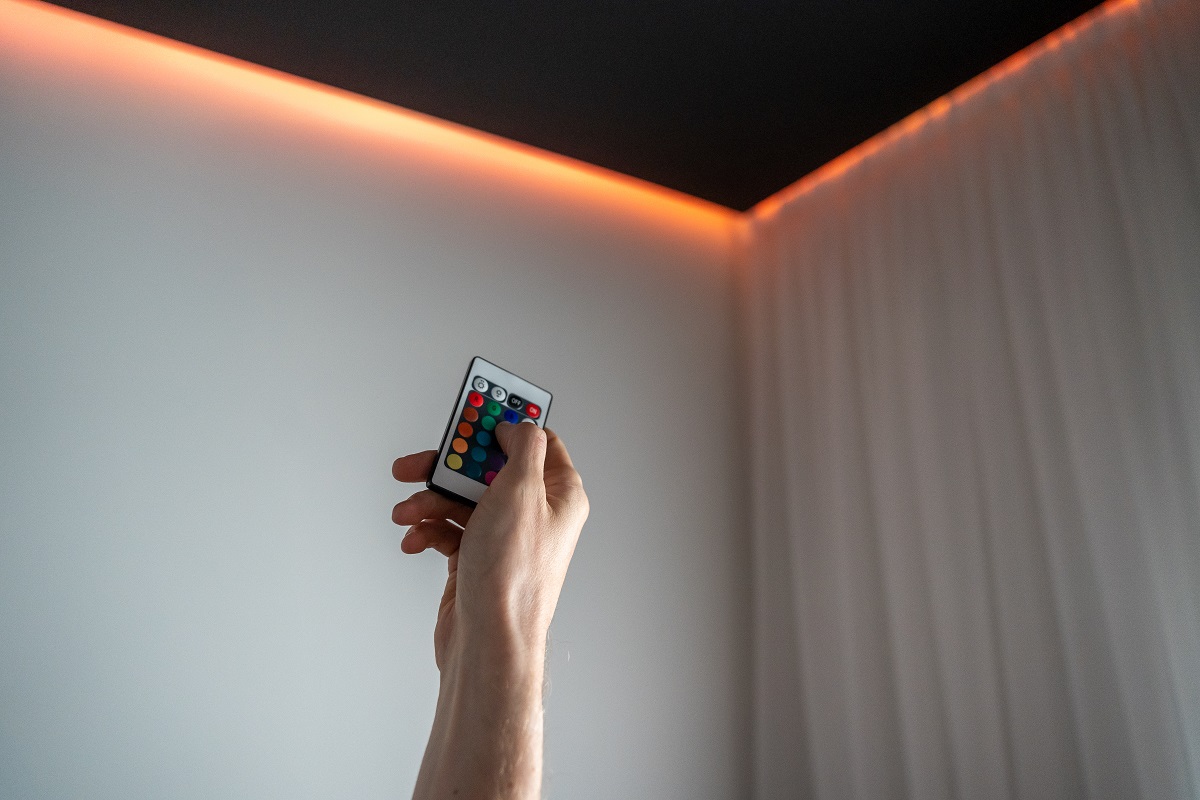 Smart controls add choice on top of scheduling. Our color-changing lighting systems let you adjust brightness, change colors or create preset modes from a smartphone app or with voice commands.
Smart features such as automated schedules and geofencing can adjust the lighting as you come and go. We also make sure the system works smoothly with your other smart home devices.
Landscape lighting systems from several manufacturers offer the same idea in other forms. Unique Lighting lists an internet gateway and relay among its controls, and Hinkley offers a home automation app for its landscape lighting.
Check compatibility before mixing parts. Hinkley notes that its 150W Standard Transformer cannot be used with a dimming switch, so dimming has to come from controls designed for that system.
The right control on paper still has to work in a real yard. Several local conditions change where controls go and which features matter most.
| Factor | Effect on Controls | What Helps |
|---|---|---|
| Sunset swings about 3 hours a year | A fixed on-time runs in daylight in June and starts late in November | An astronomic timer, or a photocell for the on-time |
| Daylight saving time changes | A basic timer runs an hour off after each change | A timer with automatic daylight saving adjustment |
| Tree canopy and deep porches | A photocell under cover sees less sky and reads dusk differently | Place the photocell where it sees open sky |
| Power interruptions | A clock-based timer can lose its time and settings | A timer with battery backup and memory for its settings |
Tree canopy deserves a closer look. Our guide to choosing low-voltage, solar or line-voltage lighting notes how shade affects solar fixtures, and a photocell under heavy shade faces a similar problem.
Power interruptions are the reason backup features matter. Intermatic’s EJ500, for example, keeps time for up to 3 months of power interruptions on two batteries, and its built-in memory holds settings indefinitely without them.
It helps to plan by zone. A simple starting map for most yards looks like this:
Seasonal lighting is worth its own control. UL Solutions’ holiday safety advice is to turn off powered decorations when you are not at home or while you are asleep, and a timer does that every night without anyone remembering.
Controls also support the wider goal of using less light. DarkSky International’s 2025 Approved Luminaires criteria note that approved fixtures can be combined with controls to turn off or dim them when they are not needed. For more ways to trim your power use at home, see our tips to lower your electricity bill.
The best control for your yard depends on what each area of lighting is for. Entry and path lights often suit a photocell, decorative lighting suits a photocell paired with an off-timer or an astronomic schedule, and side yards suit motion sensors.
The off-time matters as much as the on-time. Choosing when lights go out, whether at 11 PM, midnight or dawn, sets how many hours the system runs every night of the year.
Smart controls tie it all together when you want scenes, colors or control from your phone. Our landscape lighting and color-changing systems are planned with the controls chosen up front, so the schedule fits our long summer evenings and early winter dark.
If you are lighting a back deck, our guide to deck and patio lighting for New Orleans evenings covers the fixtures side. If your current controls already switch lights at the wrong times, our post on why outdoor lighting fails faster in New Orleans explains what to look for.
At TurnKey Lightings, we set up the controls with the lighting and walk you through how to use them.
To plan controls that follow our evenings, call us at (504) 688-7205.
Is a timer or a photocell better for outdoor lights?
It depends on the lighting. A photocell follows dusk on its own, which suits lights you want on all night, while a timer controls when lights turn off. Many systems use both: the photocell for the on-time and the timer for the off-time.
What is an astronomic timer?
An astronomic timer calculates sunrise and sunset and adjusts its schedule through the year. Intermatic’s EJ500 instructions say the feature automatically compensates for changes in the length of daylight, so you set it once instead of resetting it each season.
How much does sunset change in New Orleans?
About three hours across the year. The U.S. Naval Observatory lists sunset at 8:04 PM on June 21 and 5:01 PM on November 26, 2026.
Do I need to reset my outdoor light timer when the clocks change?
A basic timer needs resetting after each daylight saving time change, or it runs an hour off. In 2026, the fall change came on November 1, when New Orleans sunset moved from 6:14 PM the day before to 5:13 PM. Timers with automatic daylight saving adjustment, such as the Intermatic EJ500, handle it for you.
Where should a photocell go on a landscape lighting system?
Somewhere it can see open sky. VOLT’s transformer guide says to keep the transformer out of direct sunlight in hot climates but let its photocell be exposed to the sky, so a shaded transformer may need its photocell placed separately.
Can I control outdoor lights from my phone?
Yes, with a smart control. Our color-changing systems can be adjusted from a smartphone app or with voice commands, and features like automated schedules and geofencing adjust the lighting as you come and go.
Are motion sensors a good idea for landscape lighting?
They work well for side yards, driveways and back paths where light is needed briefly. For decorative garden or tree lighting, a photocell or timer keeps the steady glow that motion sensors would interrupt.
Can I install an outdoor lighting timer myself?
A timer made for a low-voltage transformer’s timer receptacle simply plugs in, as VOLT’s combo unit does. A timer that replaces a wall switch or connects to household wiring is 120V work, and that belongs with a licensed electrician.


