

Talk to an Expert
Talk to an Expert


An outdoor lighting transformer is the box that turns household current into the low voltage a landscape lighting system runs on. It decides how much lighting the system can carry, how evenly each fixture glows and how long the whole setup stays easy to adjust, so where it goes matters as much as which one you buy.
A transformer is easy to overlook, usually a small box on a post by the back steps. Yet every path light, uplight and accent fixture in a low-voltage system draws its power through it.
The safety case for low voltage starts there. UL Solutions notes that landscape lighting power units are limited to 15 Vac or 30 Vdc output, which presents no risk of electric shock under wet conditions.
At TurnKey Lightings, we plan outdoor lighting around the fixtures, the placement and the power behind them, and the transformer is one of the first things we size on any yard.
If you are adding lighting or extending an older system, contact us and we can look at the transformer side of the plan with you.
This guide explains what the transformer does, how it delivers the right voltage to each fixture, how to size it and where it belongs in a New Orleans yard.
An outdoor lighting transformer steps household power down to low voltage and isolates the lighting circuit from the house wiring. Kichler describes its 300W Pro Series unit as one that reduces standard 120V line voltage to 12V low voltage.
The isolation part matters as much as the voltage. UL 1838, the standard for low-voltage landscape lighting systems, describes a complete system as an isolating type power unit, low-voltage cable or flexible cord, and luminaires. The standard covers power units where each output circuit is rated at a maximum of 25 A.
UL Standards & Engagement also states that this equipment is intended to be installed in accordance with Article 411 of the National Electrical Code.
Depending on the model, the box can hold:
Not every unit has all of these. Hinkley’s 150W Standard Transformer, for example, features a 12v tap, an automatic timer and a photocell, while larger units add more taps and circuits.
One boundary never changes. The transformer plugs into a 120V receptacle, and VOLT’s installation guide is direct about it: only licensed electricians can work with 120V wiring.
A transformer delivers the right voltage by letting each wire run connect to a different output tap. The tap is chosen so the fixtures at the end of that run still receive a voltage they can use, after some is lost along the cable.
Each wire pair from the yard is split at the transformer. VOLT’s guide explains that one leg goes to a common tap and the other leg goes to a voltage tap.
A multi-tap transformer offers a choice of voltages for those connections. Kichler’s 300W Pro Series unit, for instance, includes two 15V taps alongside its two commons.
VOLT’s guide says selecting a higher voltage at the transformer compensates for voltage that may be lost along wire runs. The goal is simple: every fixture should land inside its acceptable range, which VOLT lists as 10.5V to 12.0V for halogen and 9V to 15V for LED.
Voltage loss depends on three things: distance, lighting load and wire gauge, according to VOLT. A long run carrying many fixtures on thin cable loses the most.
VOLT gives a formula for it: run length times load times 2, divided by the cable constant. Its worked example is a 100-foot run carrying 150W on #12/2 wire, which loses 4V. Adding that loss to 12V points to the 16V tap so the fixtures still receive about 12V.
Unique Lighting Systems offers a quicker rule of thumb for LED systems: on 100 feet of 12/2 wire, every 35 VA of load costs about 1 volt. It also advises using VA in place of watts for LED, because volt-amps reflect the LED chips plus the driver draw.
After installation, the voltage is checked with a meter at the fixtures, ideally with every fixture on so the system is tested under full load, as VOLT recommends. Wires then move to a different tap if needed.
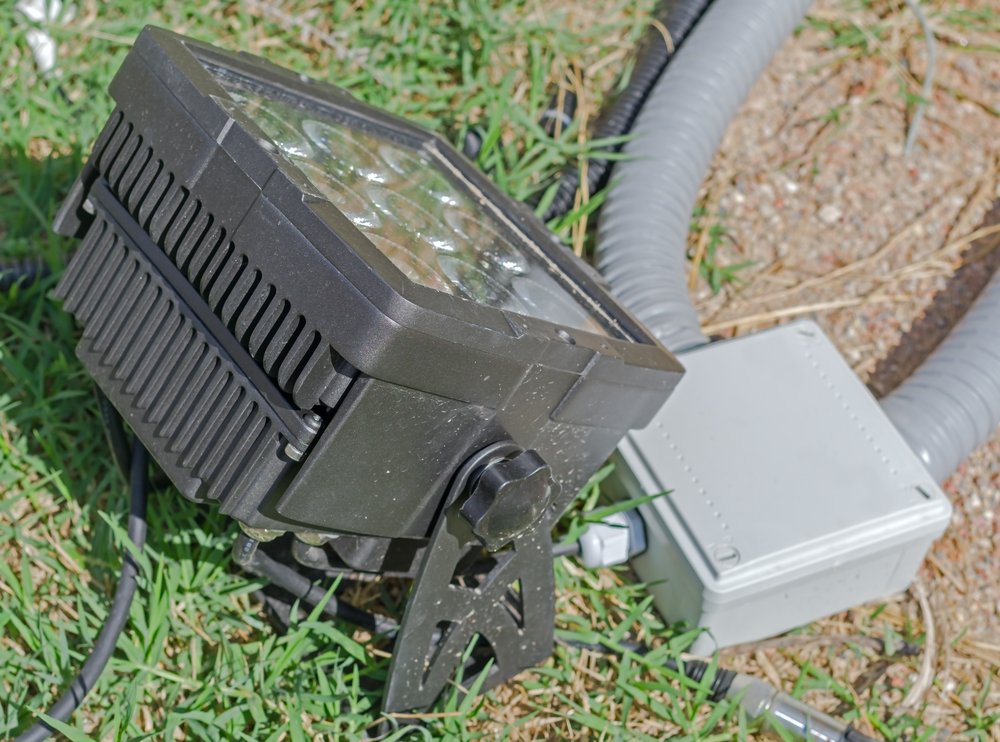 How the cable is laid out changes how much voltage each fixture sees. VOLT describes three main methods:
VOLT notes that daisy chain and T layouts can lose significant voltage from the first fixture to the last, though the T-method performs better. It recommends them only for shorter runs and LED fixtures with wide voltage ranges. For LED systems, a combination of hub, daisy chain and T wiring is the method VOLT says best conserves wire and labor.
A transformer should be large enough that the total lighting load stays under about 70 percent of its capacity. VOLT’s sizing rule is to divide the total fixture load by 0.7 to find the minimum transformer capacity.
VOLT’s own example shows why the margin matters. A system with fixtures totaling 230 watts, divided by 0.7, needs at least 329 watts of capacity. A 300W transformer would be too small, and a 600W model would be the better fit.
LED systems add one more step. VOLT says that when the system uses LED sources, fixture wattage should be divided by the power factor, or by a typical value of 0.7 if the actual power factor is not known. Unique Lighting reaches the same point another way, by sizing on VA rather than watts.
Wire runs have their own limits too. VOLT lists suggested maximum loads on a single wire:
VOLT also advises spreading loads among wire runs and common taps rather than stacking them on one terminal.
Future plans belong in the sizing too. Unique Lighting suggests considering a larger transformer to allow future expansion, so tree or deck lighting added later does not force a replacement.
If you are still deciding between low-voltage, solar and line-voltage lighting, our guide to choosing an outdoor lighting system in New Orleans compares all three.
A transformer should sit above grade, upright, in shade, near a protected outdoor receptacle and as central to its wire runs as the yard allows. Each of those choices traces back to the manufacturer’s instructions and to local conditions.
VOLT’s guide says the power supply must be mounted vertically with the bottom plate at least 1 foot from the ground. It should go on a solid surface or a stand, leveled so it hangs straight.
Treat that height as a minimum here. NOAA’s 1991 to 2020 normals for the New Orleans International Airport station show 63.35 inches of rain in an average year, and a higher mount in a low spot keeps the electronics farther from standing water.
The outlet matters just as much. VOLT requires a GFCI-protected receptacle, and an outdoor receptacle must have an in-use weatherproof cover. Adding or moving that receptacle is 120V work for a licensed electrician.
VOLT’s guide notes that it is normal for the transformer to become hot. It says not to let the unit touch PVC or plastic siding, which rules out mounting it flat against many vinyl-sided walls.
Heat from the sun adds to the heat the unit makes. VOLT advises that in hot climates the transformer should avoid direct sunlight, while its photocell, if it has one, stays exposed to the sky. NOAA’s normals put the average summer high at 90.9 degrees F at the New Orleans airport station, so shade is worth planning for.
Water features set firm distances. VOLT says to install the power unit at least 5 feet from a pool or spa and at least 10 feet from a fountain. Near salt water, it recommends enclosing the unit in a weatherproof structure.
Placement also shapes voltage drop. Because loss grows with distance, a transformer tucked in a far corner forces long runs to the other side of the yard, which may push those runs onto higher taps or heavier cable.
Unique Lighting suggests calculating voltage drop for the most critical runs: the longest one and the one with the most load. Placing the transformer near the middle of those runs can shorten both.
Indoor mounting is possible on some units. VOLT says its power supplies are indoor and outdoor rated but recommends outdoor mounting, because indoor installs must follow the codes for wires passing through exterior walls. UL 1838 likewise says power units are installed indoors or outdoors according to the marking on the product.
For a clean finish, VOLT notes that running the wire through conduit from the transformer into the ground looks neater.
The transformer is easy to overlook, but it sets the limits for everything else in a low-voltage system. Its size decides how many fixtures you can add, its taps decide how evenly they glow, and its placement decides how hard it has to work in our heat and rain.
That is why a good plan starts with the yard as a whole. Where the outlet is, where the longest runs go and where water collects after a storm all shape where the transformer belongs. Our landscape lighting and pathway lighting layouts are planned with the power side in mind, from pathway lighting spacing to lighting live oaks and mature trees.
Climate is part of the plan as well. Our post on why outdoor lighting fails faster in New Orleans covers how heat, humidity and storms wear on outdoor systems.
At TurnKey Lightings, our residential lighting plans set the fixtures, the placement and the power behind them for the effect you want.
To plan a transformer that fits your yard, call us today at (504) 688-7205.
Add up the load of every fixture, then divide by 0.7 to find the minimum transformer capacity, which keeps the load under about 70 percent of the rating. That is the rule in VOLT’s installation guide. For LED fixtures, VOLT also divides fixture wattage by the power factor, or by 0.7 if the power factor is unknown, and Unique Lighting recommends sizing on VA instead of watts.
Voltage is lost along every wire run, and long or heavily loaded runs lose more. A multi-tap transformer lets each run connect to a higher output, such as 13V, 15V or 16V, so the fixtures at the far end still receive a usable voltage. VOLT’s guide gives an example: a 100-foot run carrying 150W on #12/2 wire loses about 4V, so it goes on the 16V tap to deliver about 12V at the fixtures.
VOLT’s installation guide says the transformer must be mounted vertically with its bottom plate at least 1 foot from the ground. In low-lying New Orleans yards where water collects after heavy rain, placing it higher on a solid post or wall adds a margin above that minimum.
No. VOLT requires a GFCI-protected receptacle, and an outdoor receptacle needs an in-use weatherproof cover that protects the plug while it is connected. If the outlet you have does not meet that, adding or upgrading it is 120V work, and VOLT’s guide states that only licensed electricians can work with 120V wiring.
It depends on the load and the wire gauge. VOLT’s sizing flow chart steps up from #12/2 to #10/2 or #8/2 cable as the farthest run gets longer, and its voltage-loss formula shows how much each run will drop. Unique Lighting’s rule of thumb is about 1 volt lost for every 35 VA on 100 feet of 12/2 wire.
The low-voltage side is designed to be. UL Solutions says landscape lighting power units are limited to 15 Vac or 30 Vdc output, presenting no risk of electric shock under wet conditions. The 120V side is different: the receptacle and the circuit feeding the transformer are household wiring and belong with a licensed electrician.
Shade is better here. VOLT notes that transformers normally get hot and advises that in hot climates they avoid direct sunlight, while any built-in photocell stays open to the sky so it can read daylight. A shaded wall or post is usually the better spot in our summers.
Some can. VOLT says its power supplies are rated for indoor and outdoor use but recommends mounting them outdoors, because an indoor install must follow the codes for wires that pass through exterior walls. UL 1838 also says power units are installed indoors or outdoors according to the marking on the product, so check the label on your unit first.


